
All electrical devices require some form of control to function as intended. Control and regulation are often associated with machines or processes, but they can encompass everything from simple switch control to complex systems with sensors and detectors. In smaller devices, circuit boards and memory chips are used for control, while larger and more complex systems require additional components. Historically, Control Cabinet or Control Panels have been used to address this issue. An Control Cabinet generally involves a certain amount of power distribution, while a Control Panels is more focused on control, regulation, and monitoring. Rapid advances in automation are blurring the distinctions between these types.
Control cabinets are used to manage various aspects of turbine control, protection functions for generators, or process functions for offshore gas installations. This type of process-critical equipment has significant requirements for robustness, reliability, and functionality. Our customers come from commercial, offshore, and military applications, where we can offer control equipment for all these markets.
Control panels are used in industry and buildings to control and regulate lighting, heating, ventilation, process automation, and power circuits. Elektromontage can deliver systems designed and manufactured according to IEC, ATEX, UL/CSA, and even EAC standards. We also design and produce automation equipment for marine applications, which can be classified according to marine classification societies and meet requirements for shock and/or ATEX regulations.
Control panels contain components such as switches, contactors, overcurrent protection, measuring equipment, monitoring units, and communication devices. A control cabinet is often more geared towards a process or machine and therefore contains equipment specifically tailored for this purpose. It may include control systems, vibration monitoring systems, relay protection, and other peripheral devices.
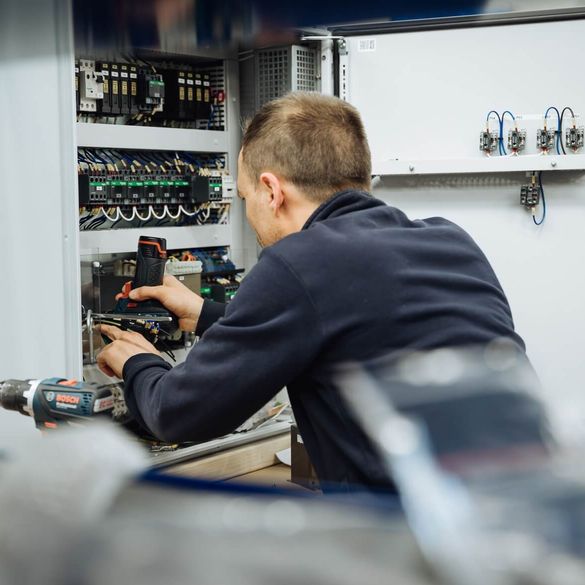
Elektromontage’s work is often carried out in close collaboration with the customer, with the shared goal of delivering a customized system in which functionality—along with personal safety, operational reliability, and energy efficiency—always takes top priority. Many of our customers value the peace of mind that comes from having a supplier who takes responsibility for the entire process—from design to the manufacture of complete systems, and from control systems to power distribution on the machine or within the facility.
Here you'll find answers to frequently asked questions about Control Panels and Control Cabinet, their functions, and their uses.
A Control Cabinet is a central unit designed to house, protect, and organize electrical components and control systems used to monitor and control various types of electrical installations. This can include everything from advanced control systems for the process industries to solutions for building automation and energy distribution. The cabinet’s design not only ensures protection against external influences such as dust and water but also provides a structured environment for efficient cable management and easy access for service and maintenance. At Elektromontage , we focus on developing custom-designed Control Cabinet that precisely meet our customers’ unique needs, with a high standard of safety, functionality, and adaptability. Our goal is to deliver solutions that are not only technically optimal but also help simplify operation and maintenance for users.
The needs for industrial automation are multifaceted and include increased efficiency, precision, and productivity. Automation minimizes human error and contributes to consistent quality in manufactured products. It also enables flexibility in production, allowing for quick and efficient adaptation to new products. Furthermore, improvements in the work environment are a key aspect, as automation can relieve staff of monotonous and potentially hazardous work. At Elektromontage , we ensure that our customers’ automation needs are met by offering innovative solutions that not only optimize production but also support sustainable development and competitiveness in the market.
Industrial automation and control technology encompasses the design, implementation, and maintenance of technical systems and software solutions for controlling production processes and machinery. These systems enable industries to achieve high precision, efficiency, and reliability in their production. By utilizing a wide range of technologies, such as PLCs, sensors, and networking solutions, automated systems can monitor and adjust production processes in real time. At Elektromontage , we combine our technical expertise with innovative control technologies to develop customized automation solutions that meet our customers’ specific needs, helping to optimize their operations and promote growth.
In industrial automation, several key components are essential for building efficient and reliable systems. These include design and configuration software for creating and fine-tuning automation processes, integrated architecture to simplify integration and communication between different system components, and intelligent motor control for efficient control of machinery. At Elektromontage , we are dedicated to utilizing and integrating these components to create advanced automation solutions that improve our customers’ productivity, safety, and operational efficiency.
An automation system is an integrated network of control units, software, and equipment designed to automate and optimize various processes within an organization. By using technology to replace or assist human efforts in production, handling, and monitoring, companies can achieve greater efficiency, precision, and speed in their workflows. These systems can be adapted for a wide range of applications, from manufacturing and warehouse management to building automation and more. At Elektromontage , we specialize in developing and implementing customized automation systems that not only improve productivity but also help reduce costs and enhance workplace safety.
Automated production refers to the use of control systems, machines, and information technology to carry out production processes with minimal or no human intervention. This means that tasks that previously required manual labor can now be performed more quickly, more consistently, and often with higher quality through automated systems. The benefits of automated production include improved efficiency, reduced production time, and lower labor costs. At Elektromontage , we view automated production as an opportunity to offer our customers customized solutions that meet their needs for high productivity and quality, while contributing to a sustainable and future-proof industry.
A Control Panels contains various components needed to control, regulate, and monitor machines or industrial systems. The most important components include switches, indicators, circuit breakers, relays, contactors, programmable logic controllers (PLCs), power supplies, and terminal blocks.
Each component has its own function, such as starting and stopping processes, protecting equipment against overload, or enabling precise control of various functions. The control cabinet serves as a central hub for monitoring and regulating complex systems, thereby contributing to safe and efficient operation.
A Control Panels centralizes control and coordinates communication between various devices and machines in an industrial system. It receives signals from sensors, operators, or external systems and processes them using, for example, programmable logic controllers (PLCs) or relays. It then sends control signals that activate or deactivate various devices as needed.
The control cabinet also supplies components with the necessary power and contributes to safe operation through the use of circuit breakers and fuses, for example. It also enables continuous monitoring and adjustment of the system’s functions.
Through this coordination, operators can control and optimize processes from a single interface, which improves the system’s efficiency and safety.
A variable frequency drive (VFD) cabinet is a cabinet that houses a variable frequency drive (VFD), which controls the speed of an electric motor by adjusting the frequency and voltage supplied to the motor.
Variable frequency drive cabinets are used in industry to control the speed of, for example, feed pumps, fans, and conveyor systems. This can improve operational efficiency and reduce energy consumption.
The enclosure protects the variable frequency drive from external influences and is designed to ensure adequate ventilation. It may also contain supplementary control equipment and protective devices that contribute to safe and reliable motor operation.
A transformer control cabinet is a custom-designed cabinet that contains components for controlling, protecting, and monitoring a transformer’s operation.
The cabinet may contain control relays, protective devices, measuring instruments, and switching and circuit-breaking equipment. The components may be divided into different sections to separate power circuits from control and signal circuits, which contributes to safe operation and facilitates maintenance.
The design enables effective monitoring and control of the transformer and contributes to a safe and reliable power supply in industrial facilities.
The primary purposes of a control cabinet are to control, regulate, and monitor electrical systems, machines, and industrial processes.
The control cabinet facilitates interaction between operators and electrical systems by bringing together key components for control and automation in a central location.
It contributes to more efficient operation, increased safety, and enables operators to monitor system performance and adjust its functions as needed.
UL 508A is a U.S. safety standard that applies to industrial control panels and Control Panels (Industrial Control Panels). The standard includes requirements for, among other things, component selection, design, wiring, labeling, and short-circuit current rating.
Manufacturing Control Panels in accordance with UL 508A can be important for equipment intended for installation in the North American market. The standard helps ensure that control cabinets meet relevant safety requirements and can facilitate approval and installation.
The UL requirements for industrial Control Panels include, among other things, safe design, proper component selection, wiring, labeling, and documentation.
For Control Panels covered by UL 508A, for example, requirements include proper component sizing, calculation of short-circuit current ratings, and clear labeling of electrical ratings.
The purpose is to reduce the risk of electrical faults and contribute to safe installation, operation, and maintenance. The specific requirements depend on the control cabinet’s design, intended use, and the market in which it will be installed.
The difference between UL 508 and UL 508A lies primarily in their scope of application.
UL 508 was a standard for industrial control equipment and covered individual components, such as relays, contactors, and other equipment for industrial control systems. The standard has largely been replaced by newer standards for corresponding products.
UL 508A, on the other hand, applies to industrial control panels and Control Panels as complete units. It covers requirements for, among other things, design, component selection, wiring, and short-circuit current rating.
UL 508A thus focuses on the safety of the finished control panel, whereas UL 508 historically covered individual control components.
A UL 508A-Control Panels is an industrial Control Panels that has been designed and manufactured to meet the requirements of the UL 508A safety standard.
The standard sets requirements for, among other things, component selection, wiring, labeling, and short-circuit current rating. These requirements contribute to safe and reliable operation in industrial environments.
Control Panels that are certified to UL 508A can facilitate approval and installation in markets where compliance with U.S. safety standards is required.
ATEX and IEC have different roles in electrical safety and explosion protection.
ATEX encompasses EU regulations for equipment and protective systems intended for use in potentially explosive atmospheres. The regulations require that the equipment be safe to use in environments where explosive gases, vapors, or dust may be present.
The IEC (International Electrotechnical Commission) develops international standards for electrical and electronic equipment, including equipment for potentially explosive atmospheres. IECEx is an international certification system for such equipment.
ATEX applies within the EU, while IEC standards and IECEx are used internationally. Both contribute to creating safer solutions for potentially explosive atmospheres.
An ATEX environment is an area where flammable gases, vapors, mists, or combustible dust can form an explosive atmosphere.
Examples of ATEX environments include oil and gas facilities, chemical plants, mines, and facilities for the storage or processing of grain. In these environments, flammable substances or dust particles can ignite and cause explosions.
Equipment used in potentially explosive areas must meet relevant safety requirements and be suitable for the area’s zone classification. The zone classification is based on how often and for how long an explosive atmosphere may be present.
ATEX areas are divided into six zones: three for explosive gas atmospheres and three for explosive dust atmospheres.
Gas zones:
Dust Zones:
Zone classification is used to determine the safety requirements and the type of equipment needed to minimize the risk of ignition and explosion.
An ATEX enclosure is an enclosure designed for electrical or electronic components used in potentially explosive atmospheres.
The enclosure is designed to help prevent electrical equipment from igniting flammable gases, vapors, or dust. Depending on the protection method, this can be achieved, for example, by limiting surface temperatures, preventing explosive substances from entering, or containing a potential internal explosion.
ATEX-compliant enclosures are used, among other places, in the oil and gas industry, the chemical industry, and mining operations. For safe use, the enclosure and the installed equipment must meet the requirements applicable to the specific ATEX zone.
Email: Phone: 0121-344 00